Weak layer adhesion
Planar paths create anisotropic strength and inconsistent structural performance.
Next-generation additive manufacturing
Quinteer combines a hardware retrofit kit with proprietary 5-axis slicing software to enable stronger parts, support-free geometries, and multi-axis manufacturing on the devices already in the field.
The problem
Existing desktop systems are constrained by planar motion, creating weak parts, excess waste, and geometry limitations that prevent high-performance manufacturing at scale.
Planar paths create anisotropic strength and inconsistent structural performance.
Overhangs demand sacrificial material, longer print times, and post-processing.
Prints leak value through support structures, reprints, and failed builds.
Stepped geometries and layered artifacts reduce precision and design fidelity.
Manufacturers are boxed into simple forms that do not reflect real-world use cases.
Complex builds spend more time on support handling than productive fabrication.
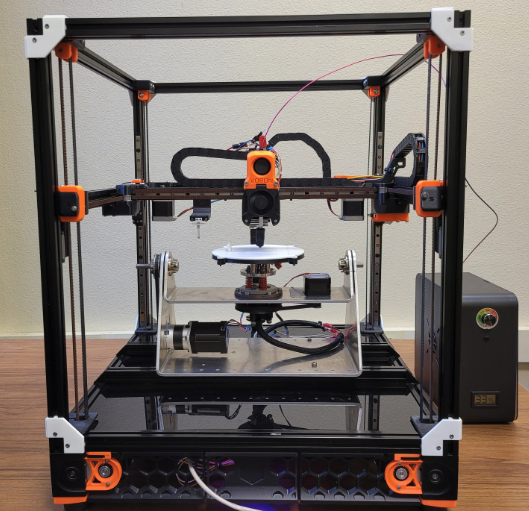
Our solution
A retrofit kit that upgrades existing desktop FDM printers into capable 5-axis systems, making high-value manufacturing accessible without replacing the installed base.
Our proprietary slicing engine generates collision-free, multi-axis toolpaths and adaptive print orientations automatically, turning every hardware node into a software-driven capability layer.
Market opportunity
Global additive manufacturing equipment, materials, and software spend.
Desktop and prosumer printer ecosystem with rising demand for advanced part performance.
Initial wedge across retrofit hardware, software subscriptions, and enterprise pilots.
Competitive advantage
| Capability | Traditional Desktop Printer | Industrial 5-Axis | Our Platform |
|---|---|---|---|
| Support-free printing | ✕ | ✓ | ✓ |
| Affordable | ✓ | ✕ | ✓ |
| Retrofits existing printers | ✕ | ✕ | ✓ |
| Automatic slicing | ✓ | ✕ | ✓ |
| Consumer pricing | ✓ | ✕ | ✓ |
| Software ecosystem | ✕ | ✕ | ✓ |
Demonstrations
Investment